The Future is Now
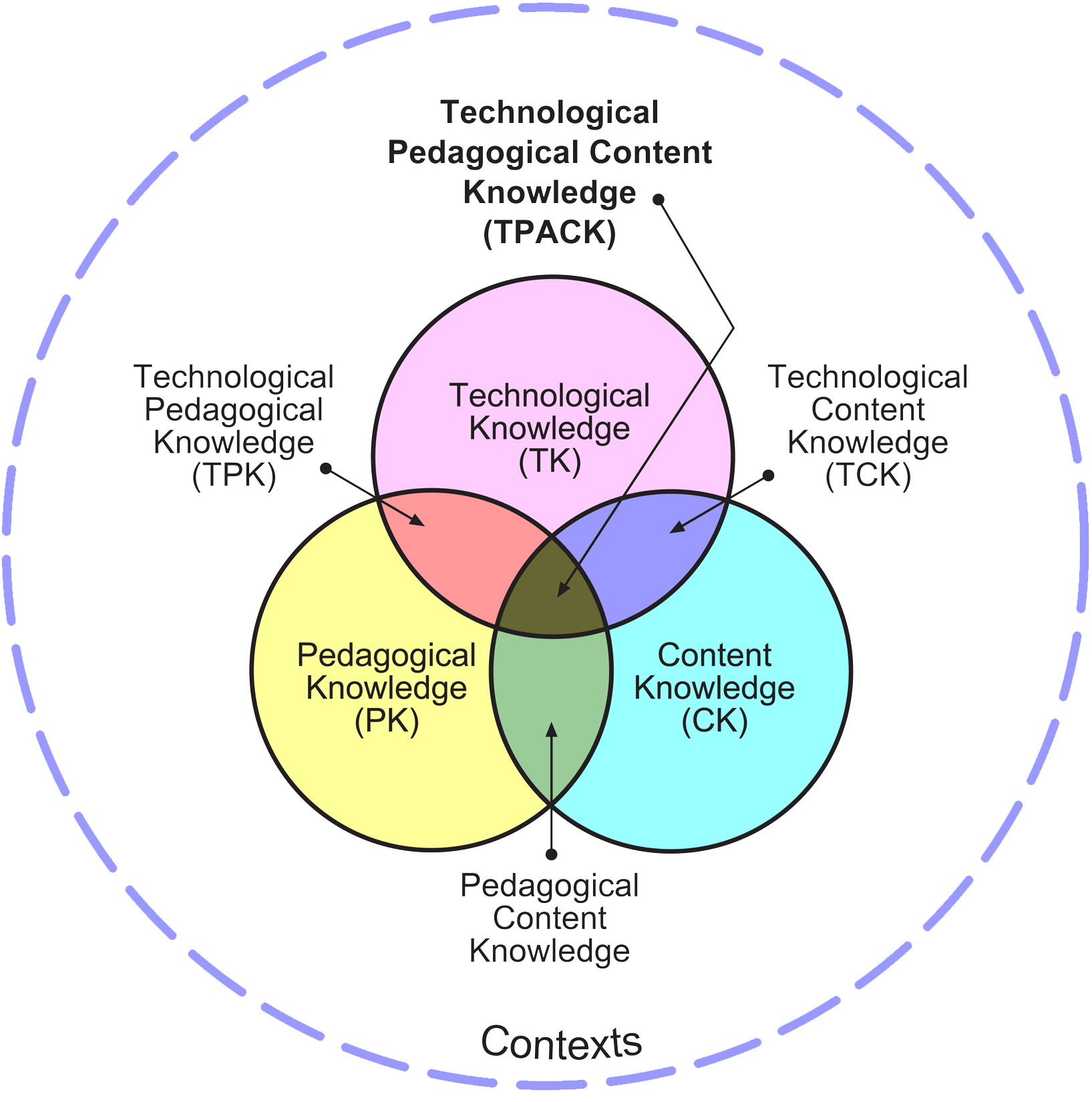
Mishra and Koehler, 2006 Michigan State University
Over the course of my teaching career I have always tried to explain mathematics as best as I possibly could to my students. I have had them take notes, given them some group work activities to do and changed some things from year to year to keep myself and my students engaged in the material that they were expected to know. What I realized is that there must be a better and different way to accomplish my goal. There is no doubt that most of what I was doing was good but there had to be a better way (to keep my students engaged and to have them retain and understand the material better). As I embarked on the journey through the master’s program much of what I had perceived internally was already apparent, but there was more to be learned. I realized how stagnant I was as a teacher, even though my perception of myself was very positive. I realized how much more I could offer my students and how much I did not up to that point. I am better than what I showed. I can do more; and furthermore, SO CAN MY STUDENTS! They can and must do more and be expected to do more and their futures depend on it. If we want the current generation to succeed we need to provide them with the opportunities, outlets and tools to be successful. I have taken several courses that have not just talked about the incorporation of technology in class for technology’s sake; but for the opportunity to bring more technology into the classroom to enhance student understanding and more importantly relational understanding. The following three ideas synthesize what I have taken away from my master’s education.
Relational understanding is the ability to know what is going on in the problem and to truly understand what is taking place. Being a high school mathematics teacher, my main focus for this is in the area of mathematics education. Relational understanding is the goal of mathematical education; although most mathematical educators teach instrumentally. Instrumental understanding is knowing the process of how to solve and approach a problem. The Ying and Yang of these two types of understanding is that they both have positive attributes and have a significant impact at all levels of mathematics, but relational understanding is the goal. Not only do you understand the instrumental side of things, but you also understand the depth and scope of the problem and how to look and observe it. No matter what additional problems you come across you will understand how to solve them and what is being asked and how to explain the problem and the solving process. Relational understanding is not easily forgotten where instrumental understanding is more easily forgotten and I want my students to walk away from a class and always remember the material that was covered. I have taken many classes over my educational career and much of the material I was required to learn has since been forgotten, even though I received good grades.
I have taken two courses, CEP 805 Learning Math with Technology and CEP 822 Approaches to Educational Research, that talk about this idea of relation versus instrumental understanding. One was specifically designed for teachers of mathematics and the other class was a psychology class. The same video was shown in both classes. The video was an educational documentary of a high school classroom. The specific topic was about what causes the change of seasons and could students explain this concept. The teacher had a physical model that she used to explain how everything took place. When the questioners (documenters), asked the students to explain this concept all of them had a very difficult time. They were given multiple opportunities to show what they knew. They could explain this concept verbally, draw a picture, and write out a description. They had difficulty explaining this. They then asked the teacher who she thought was the most knowledgeable and best student in the class and who the teacher thought would be able to explain this concept. The student failed miserably at her explanation made up some of her own ideas to provide reason to her explanation. She also had a difficult time allowing herself to get rid of her known issues with this concept even after it was explained to her how wrong she was. This was a very interesting and poignant representation of what we think our students are walking away from our classes with. They have the ability to convince us that they know the material and yet they truly have little clue. Unless a concept is continually applied the students will forget.
I was very concerned about this and about what my former students might not know because of the way I have taught. Do they really remember? Do they just remember for the test? Do I need to review more or test a different way? Not long after watching this video one of my students in Pre-Calculus, ONE OF MY TOP STUDENTS was tutoring an underclassman and came to me with a question. He was tutoring an underclassman in Algebra and had a question about the equation of lines and how to graph them in slope intercept form and in standard form. I was floored. Surely, a student in Pre-Calculus should know how to graph an equation of line no matter what the form! He did not and he was one of my best, what had I done.
There is still time. I am always one to look in the mirror and ask questions to myself about how I teach and how I can improve. I looked back and when I used to provide examples on the board, I would show how the problem came to be and how to solve each step along the way and then get the answer. When I would go over additional examples with similar problems, I realized I was asking the students what the next step in the problem would be. This was bad. I was really providing and prompting the next step for them. They did not really need to think and there would often times be a 50/50 shot on what the correct answer would be. I needed to change my approach and because of that video I have begun to ask more open ended questions to my students about how to solve a problem and asking why, while at the same time allowing some time allotted for dead time.
One of the things I also found myself not doing was allowing for uncomfortable silences. Or for opportunities to give students more time to think about the problem and the scenario. By doing this, I have found that my students are more engaged in the material and know they are expected to truly know. It is also necessary to point out; there is a time when the show must go on. Although, there are students that do not have the relational understanding down it is necessary to move onto the next topic and try to bring those previous ideas back into the current or future discussion. Class needs to surge forward and trudge through and the goal should always be for all students to gain relational understanding but realize that instrumental is also important and at a minimum, students should have that before progressing to the next concept.
One of the other items I have observed both as a teacher and as a parent is the influx of technology into every aspect of daily life. My daughters will and are working with it right now at the ages of 4 and 6. The amount of technology I use right now is different from 10 years ago when I first started teaching. There are some teachers that do not believe in its benefits. As a high school math teacher, my colleagues and I are always discussing how the students right now have a difficult time with the ability to do long division, multiplication and addition and subtraction of fractions, integers (both positive and negative), and decimals by hand. They have been given the exclusive ability since they were younger to use calculators without truly understanding what has taken place and not knowing if they are right or wrong and just writing down what the calculator told them. This is that idea of technology not being used the correct way and although the calculators are wonderful tools they hinder some of that other understanding, relational understanding. How do we accomplish this better? How do we all get on the same page?
One of the ways this can be accomplished is by being a good leader and a catalyst of change. An idea discussed extensively in CEP 815 Technology and Leadership. Whether or not anyone wants to admit it, things are always changing. Nowhere is this more apparent than in education. The students have laptops, iPads, phones and other electronic devices that they are going to use, and let’s be honest they are going to continue to use whether we ban them or not. So let us embrace this technology and try to use it for ours and their benefit. The way this must come to fruition is through positive and good leadership. In order for change to occur a good vision must be in place. The skills in order for the goal to be a success must be taught and addressed with all of those involved in change. Incentives must be given for those individuals to learn the new skills (incentives, motivation, whatever you want to call it all need to buy in, some do it naturally others need to be motivated and given reason why something is important. They need to see the value.) The resources need to be addressed as well. There is no use having a good idea if the capital or the resources are not there to make this attainable. The last thing that needs to be put in place is a thorough action plan.
There are pitfalls to not having all of these items in place. If Change is needed and items are missing there will be consequences. Remember in order for Change to take place a good vision must be apparent, the necessary skills must be taught, incentives must be explained, resources must be made available, and an action plan must be laid out. If everything else is in place but the vision is missing, everyone will be left with a feeling of confusion. If everything is present except the skills, then people will be left with a feeling of anxiety. If everything is present besides incentives, individuals will have a feeling of resistance to the change that is about to go down. If the resources are unavailable, then there will be a prevailing wind of frustration that will be felt. If there is no action plan then everyone will feel like there are on a treadmill because they will not be sure what is really going on and if they are doing everything up to expectations. Change is good but it needs to be thought through and executed properly to achieve the goal.
More and more educators discuss how things were different when they were students. All of us tend to associate a negative connotation with this idea of change. There is one thing that is true; things and times are different from what they were but the students are the same as they have always been. Some are driven. Some are arrogant. Some are guarded. Some are naïve. Some are immature. Some are wise beyond their years. Students are students like they have always but the tools they navigate the world with have changed and are much different. What they have at their fingertips is much different than in years past. Why then do we continue to teach them the same way we have done in the past.
We have an opportunity to help students learn and achieve more than we could have ever imagined. We have the opportunity to facilitate learning and take our students further than possible. As all educators are aware, learning takes place all the time and not is not exclusive to the classroom. Many of our students, when they want to learn or research something, venture off on the internet to do the research or learn, through various sites such as Google or YouTube. We can provide the classroom experience in entirely different way than the traditional setting and providing normal classes, enrichment classes, or remediation for students.
There is no doubt this is a difficult task and assumes a lot. The students need to have internet access at most times, inside the school building and at home, in order to access the classroom? How will a daily school environment of this look like and how can this be accomplished? These are some of the many issues that would have to be resolved. There are so many ways to develop online courses to meet student’s needs. There are different webservers and applets that students can do in order to understand the material. Some subjects lend themselves more naturally to the online learning environment, but all subjects are capable of being an online class.
I have learned a lot and will continue to educate myself and others as I progress through my masters and beyond. What I have truly walked away with is how much potential there is with what technology can currently do and how everything cannot be accomplished with a flick of the wrist. Students need to be pushed towards relational understanding. This is challenging can be done with the correct type of teaching and facilitating the proper classroom environment. Change can only happen he other idea that speaks to the forefront of change that is taking place is the learner. What can be done for them? We can create learning opportunities where they can educate themselves constantly, dynamically, and study the material with more depth than they have ever done before. There is a constant relationship is taking place of how our content, pedagogical, and technological knowledge (TPCK) is intertwined (Mishra & Koehler, 2006). The understanding of the impact each has on the other helps us understand our students and the current educational climate and are represented in the three ideas I laid out in the previous paragraphs.
by: Brian Bedard
 Brian Bedard's